
The vagus nerve – why it is so important and how we can specifically support it.
- sandrahirschberger
- Dec 12, 2025
- 4 min read

Updated with new insights into the autonomic nervous system: Naturally calming. Scientifically proven. Treated by osteopaths for decades.
And yet, when it comes to the vagus nerve, things are often portrayed too simply. It is a central part of the parasympathetic nervous system – yes. But it is not the sole hero. The autonomic nervous system is a finely tuned interplay in which the sympathetic nervous system also plays a large and often underestimated role.
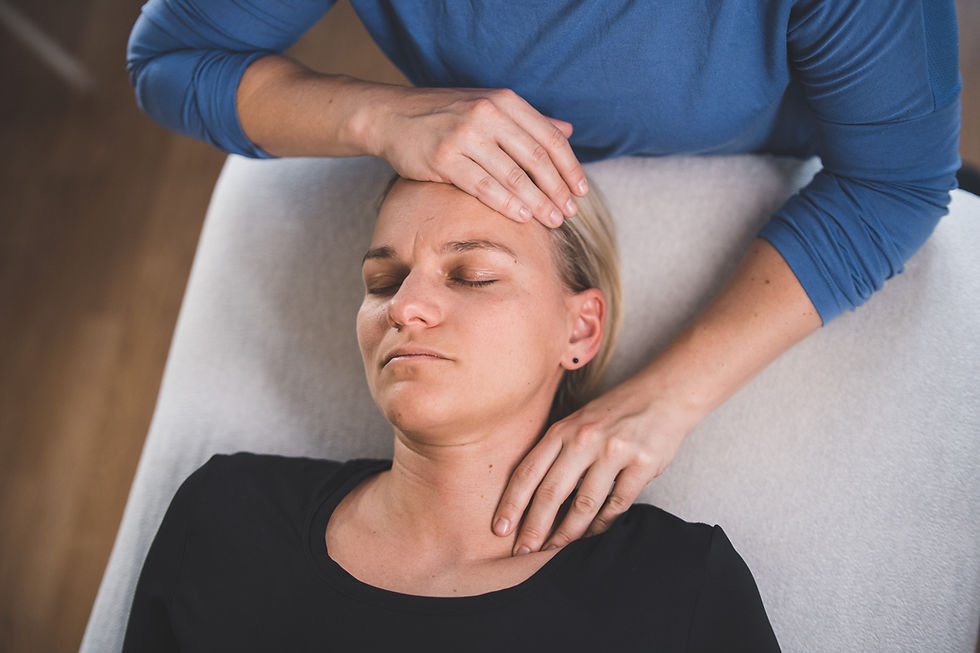
Why the vagus nerve is important – and why the sympathetic nervous system is just as important.
The vagus nerve is one of the longest nerves in the body. It connects the brain, heart, lungs, and digestive organs, and supports functions such as recovery, digestion, regeneration, and emotional balance.
At the same time, the vagus nerve only forms one half of the autonomic nervous system. The other half is the sympathetic nervous system, which by no means only generates stress and anxiety. Both systems interact, regulate different areas of the body, and ideally work together harmoniously.
Misunderstanding 1
The vagus nerve as the "good" and the sympathetic nervous system as the "bad" one.
Many ideas about the autonomic nervous system are oversimplified. The sympathetic nervous system is often seen as purely a stress or alarm mechanism, but it is incredibly versatile. It ensures that we react, act, think, and remain productive.
Intriguingly, activity in the sympathetic nervous system can even reduce pain. Research shows that the sympathetic nervous system in the spinal cord can have inhibitory effects on pain signals and also influences peripheral inflammation.
"The sympathetic nervous system is not the antagonist of well-being – it is part of its foundation."
Only when regulation is disrupted, for example by prolonged stress, chronic inflammation, or emotional tension, can the role of the sympathetic nervous system change and symptoms worsen. The problem then lies not in the sympathetic nervous system itself, but in the overall balance of the nervous system.
Misunderstanding 2
If the sympathetic nervous system is activated, the vagus nerve should be switched off.
This image is also misleading. The sympathetic and parasympathetic nervous systems don't work like two ends of a seesaw, where one system automatically wins. They often operate independently, and in many areas of the body, the vagus nerve isn't involved at all. In these areas, the sympathetic nervous system regulates all processes – perfectly normal.
"The sympathetic and parasympathetic nervous systems are not constant adversaries, but two systems that can be active in parallel."
In reality, they complement each other far more often than they block each other.
When regulation becomes unbalanced
A restricted or underactive vagus nerve can manifest itself through, among other things:
inner restlessness
disturbed digestion
Sleep difficulties
increased susceptibility to stress
However, these symptoms do not automatically mean that the sympathetic nervous system is "overactive". Often, it involves a complex interplay between both systems – and the body's ability to switch flexibly between activity and relaxation.
Osteopathy & the vagus nerve
Osteopathy has long worked with structures that influence the regulation of the autonomic nervous system – not just the vagus nerve. These include:
Techniques at the base of the skull
Diaphragm mobilization
Treatment of the rib cage and upper cervical spine
visceral techniques on organs
Releasing fascial tension patterns
The goal is always to improve the overall balance of the autonomic nervous system.
Techniques that you can use yourself
In addition to therapeutic treatments, there are simple exercises for everyday life that activate the vagus nerve:
Breathing exercises
For example, inhale for 4 seconds, exhale for 6-8 seconds.
Mobilize the rib cage
and utilizing all breathing spaces provides more freedom.
Humming or singing
The vibrations act directly on the vagus nerve, which runs through the larynx area.
Cold applications
A few seconds of cold water on the face or neck, short walks without a jacket, or ice bathing – all scientifically well-researched methods for vagus nerve activation.
Gentle neck and eye movements
Certain Neuralglide techniques can improve vagus nerve function.
Gargling / Gurgeln
A simple method that stimulates vagus fibers in the throat.
Tongue resting position
Learn the correct tongue resting position and maintain it as much as possible.
Book recommendation: "The Self-Healing Nerve" by Stanley Rosenberg
The Book of Rosenberg His work has become a classic when it comes to understanding the vagus nerve. He clearly explains the polyvagal theory, demonstrates exercises, and brings structure to a topic that is very new to many.
Modern support: Testing vagus nerve stimulation devices
In addition to manual and natural methods, there are now also non-invasive vagus nerve stimulation devices that show promising results in studies:
✓ for migraines & headaches
✓ for sleep problems
✓ for gastrointestinal problems
✓ for stress, anxiety & nervousness
✓ for cognitive impairment, e.g. in early stages of dementia
In practice, there is the possibility to try out a vagus nerve stimulation device and see how the body reacts to it.
It does not replace therapy, but can be a valuable addition – especially in cases of chronic conditions or when the nervous system is constantly in stress mode.
The vagus nerve is a fascinating link between body and mind – and at the same time a powerful key to health and inner balance. Osteopathic treatments, targeted exercises, and modern technologies can help activate it and restore its natural power.
Understanding the vagus nerve is a crucial understanding of health.


Comments